


How to Choose Furniture That Actually Fits Your Lifestyle Not Just Your Space
The essential takeaway: successful furniture selection relies on analyzing household behaviors and daily habits rather than just floor plans or aesthetics. Prioritizing realistic needs—such as durability for pets or modularity for renters—prevents expensive lifestyle mismatches, ensuring that every piece serves a functional purpose while significantly reducing long-term replacement costs.
Have you ever regretted a beautiful purchase that became a nightmare to maintain because it completely clashed with your daily reality? Successfully choosing furniture for your lifestyle means looking beyond simple floor measurements to prioritize your actual habits and household behaviors.
This guide reveals how to align your decor with your real-life needs to ensure your next investment brings lasting comfort instead of costly frustration.
- What 'Lifestyle Fit' Actually Means
- Common Lifestyle Mismatches You Can Now Predict
- Furniture Solutions for Your Real-Life Profile
- The Smart Buyer's Framework: Durability, Flexibility, and Budget
What 'Lifestyle Fit' Actually Means
So, we agree that buying furniture based on a photo is a recipe for regret. Let's get practical and define what 'lifestyle fit' really means—it's about how you live, not just the size of your room.
It’s About Behaviour, Not Just Square Metres
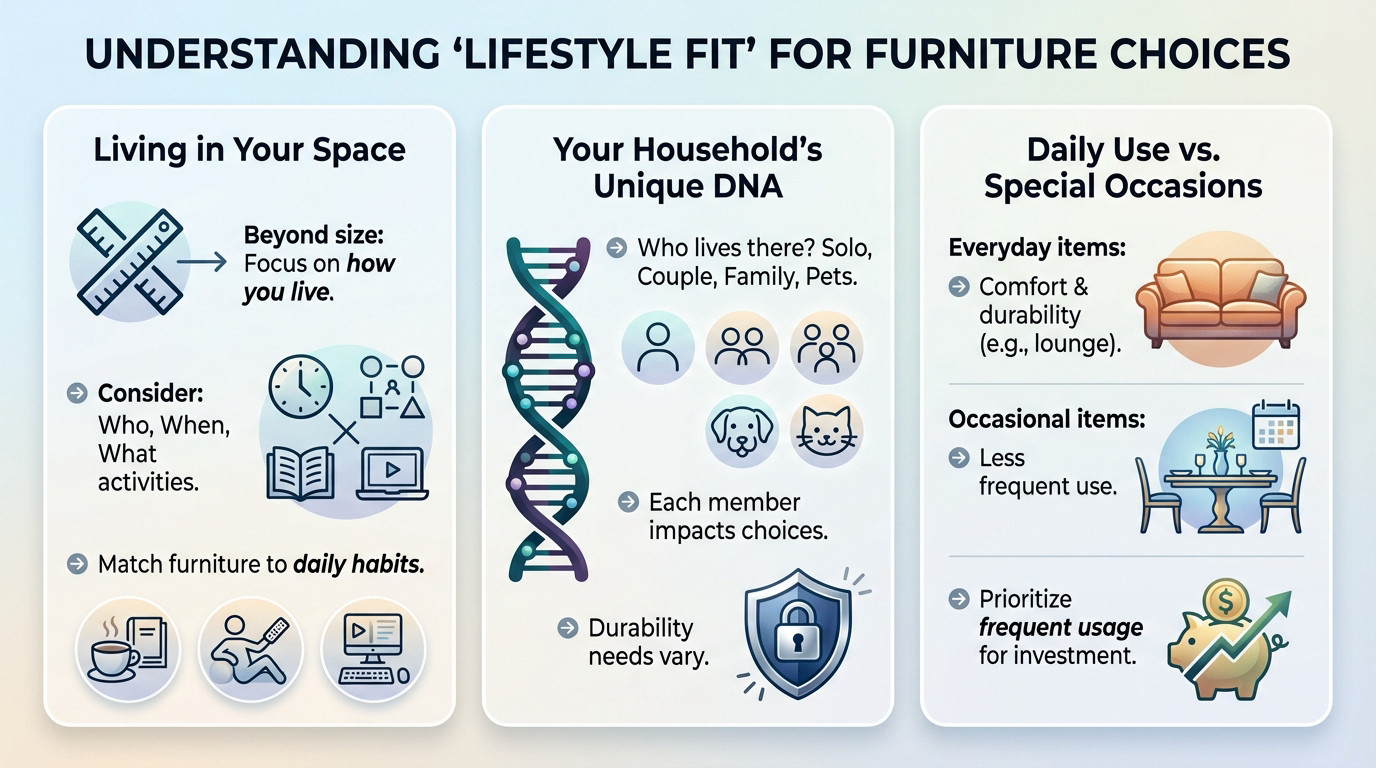
While measurements are the first step, they don't capture the full picture. The real analysis is about how you live in the space. Ask yourself exactly who uses the room, when they use it, and what specific activities happen there.
Think about the difference between two scenarios. A quiet corner for reading has totally different needs than a high-traffic hallway that kids use as a runway. The same square metres requires totally different thinking.
Your goal is to match furniture to your daily habits and behaviours, not just the floor plan.
Your Household's Unique DNA
Every household has core components that dictate what works. Who lives there? Are you a solo dweller, a couple, a family with young kids, or do you share your space with pets?
Each member—human or furry—impacts your furniture choice. A home with a boisterous dog and a toddler has vastly different durability needs than a single professional's apartment. This isn't judgement, it's just practical reality when choosing furniture for your lifestyle.
Daily Use vs. Special Occasions
We need to distinguish between furniture for everyday life and pieces for "show". The lounge you collapse onto every night needs to be a comfortable, durable workhorse that handles constant friction.
Contrast this with a formal dining table that might only be used a few times a year. Being honest about actual, frequent usage is the key to making smart choices. For pieces like lounges, check our complete guide to buying a lounge to get it right.
Common Lifestyle Mismatches You Can Now Predict
Once you start thinking in terms of behaviour, you begin to see the common traps. These mistakes are predictable, and more importantly, completely avoidable.
The Classic 'Looks Great, Feels Awful' Traps
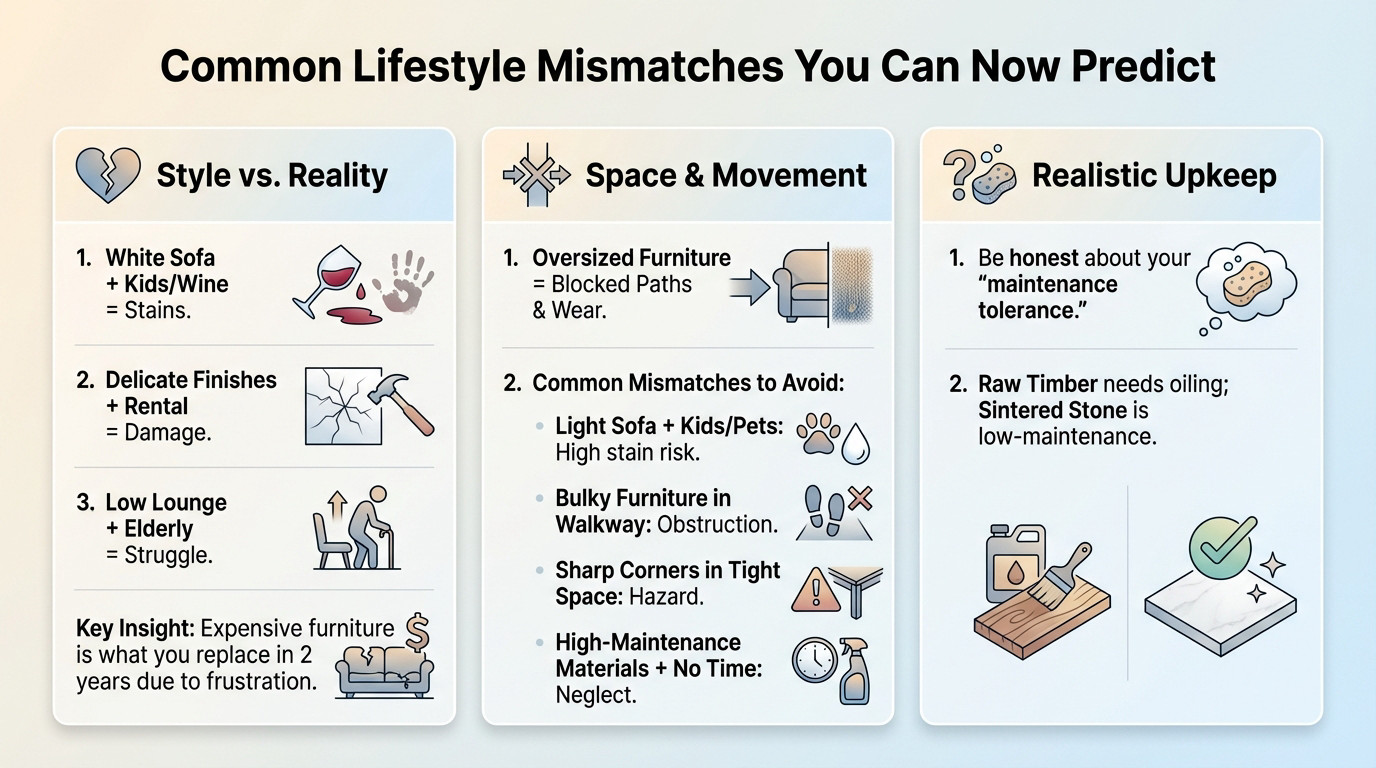
Take the infamous white fabric sofa in a home with toddlers. It’s the perfect poster child for an aesthetic choice that wages war on reality.
Consider delicate, high-gloss finishes in rentals where bumps are guaranteed, or a low-slung lounge that is a nightmare for older relatives. These aren't just annoyances; they are functional failures.
These aren't design failures. They are predictable lifestyle mismatches.
The most expensive furniture is the piece you have to replace in two years because you couldn’t stand using it anymore. It’s a constant, frustrating reminder of a bad decision.
When Size and Flow Don't Mix
Oversized furniture often blocks natural traffic flow. Imagine a giant sectional that forces a sideways shuffle to get past, creating premature wear on the corners.
This is more than an inconvenience. Poor flow causes faster wear and tear on the furniture itself, not to mention the surrounding walls and doorways.
- A pristine, light-coloured fabric sofa with toddlers or pets
- Oversized, bulky furniture in a primary walkway
- A dining set with sharp corners in a tight space
- High-maintenance materials when you have zero time for upkeep
The High-Maintenance Mirage
Be brutally honest about your "maintenance tolerance". How much cleaning will you actually do on a Tuesday?
A raw timber table is beautiful, but only if you oil it. If not, a low-maintenance choice like sintered stone is always the smarter, more realistic option.
Furniture Solutions for Your Real-Life Profile
Okay, enough about the problems. Let's talk solutions. The best way to get this right is to identify your 'lifestyle profile' and work from there.
Identifying Your Primary Lifestyle Profile
Most households fit into a few key profiles, often with some overlap. However, choosing furniture for your lifestyle requires honesty about your daily habits.
The goal isn't to be put in a box. It's to pinpoint your dominant needs to guide your priorities, whether that's durability, flexibility, or multi-functionality.
A Practical Guide to Lifestyle-Based Choices
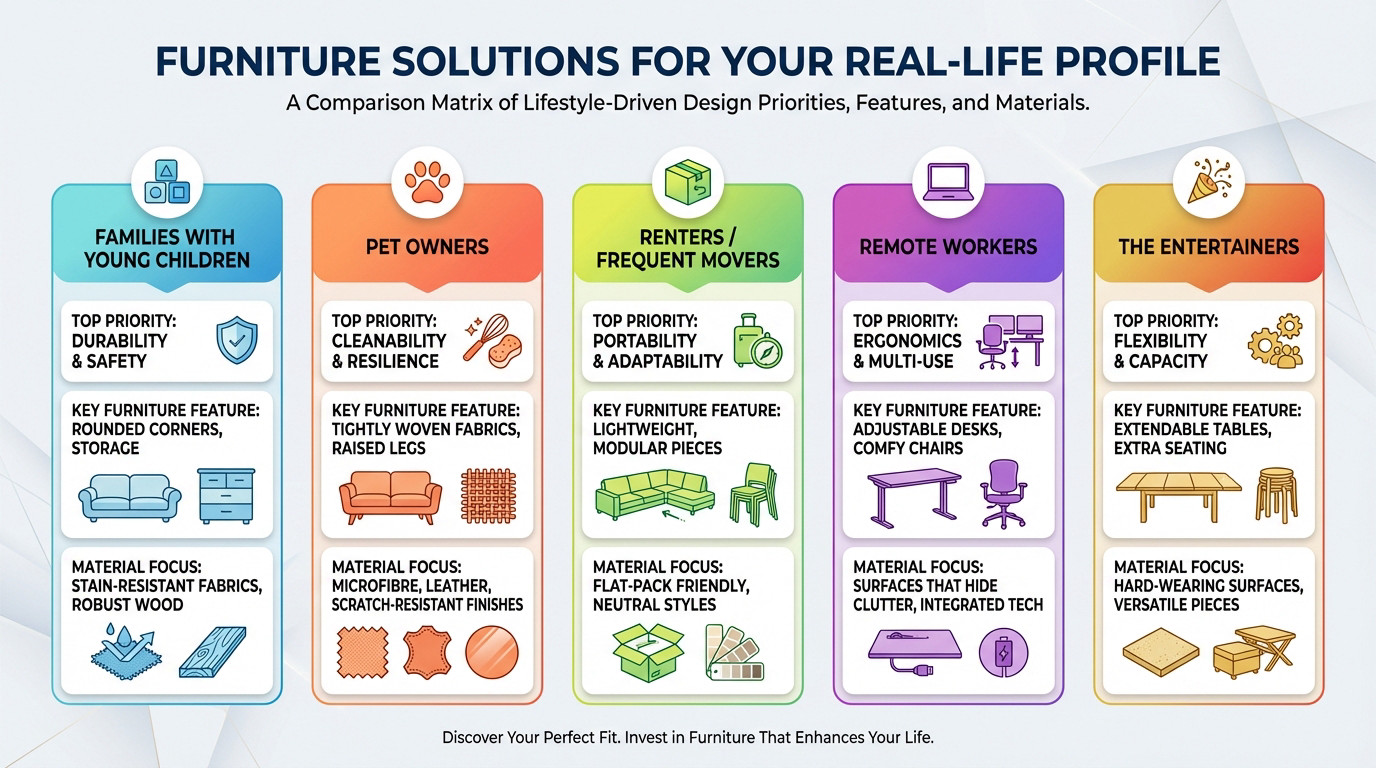
Use the framework below to compare priorities across common lifestyles. It is a simple cheat sheet for avoiding regret.
| Lifestyle Profile | Top Priority | Key Furniture Feature | Material Focus |
|---|---|---|---|
| Families with Young Children | Durability & Safety | Rounded corners, storage | Stain-resistant fabrics, robust wood |
| Pet Owners | Cleanability & Resilience | Tightly woven fabrics, raised legs | Microfibre, leather, scratch-resistant finishes |
| Renters / Frequent Movers | Portability & Adaptability | Lightweight, modular pieces | Flat-pack friendly, neutral styles |
| Remote Workers | Ergonomics & Multi-Use | Adjustable desks, comfy chairs | Surfaces that hide clutter, integrated tech |
| The Entertainers | Flexibility & Capacity | Extendable tables, extra seating | Hard-wearing surfaces, versatile pieces |
Let’s be real about the chaos. For families, safety and easy cleaning trump delicate aesthetics. For renters, modularity and portability are king, making furniture a long-term investment rather than a disposable good.
For those who love to entertain, the focus is on pieces that scale up. An extendable dining table and versatile seating like our range of lounges are non-negotiable. This shifts the focus from "what looks good?" to "what works for us?".
The Smart Buyer's Framework: Durability, Flexibility, and Budget
Durability Isn't a Luxury, It's a Saving
Durable doesn't mean boring. Materials like solid hardwoods or genuine leather actually age gracefully, while modern sintered stone offers resilience with style.
Focus on "cost-per-year" rather than the sticker price. A cheap sofa that dies in three years is far pricier than a quality one that thrives for ten.
At Fusion Furniture, we believe in investing in quality materials.
The Power of Modular and Flexible Furniture
Future-proof your purchase with a modular lounge. It adapts from an L-shape to separate seats, shifting instantly as your home evolves.
This flexibility extends lifespan, preventing the costly cycle of replacing items every time your living situation shifts.
- Adapts to new room layouts
- Can grow with your family by adding sections
- Easier to move than one large piece
- Allows for individual sections to be repaired or replaced
A Final Checklist Before You Buy
Before committing, run this mental filter. It is your best defence against buyer’s remorse.
- Who uses this piece and how often?
- What is my realistic plan for when it gets dirty or damaged?
- Can it be moved easily by one or two people?
- Does it solve a problem or just fill a space?
Good furniture should feel invisible; it seamlessly supports your life. Bad furniture is a constant reminder of a choice that works against you, day after day.
While Wayfair's AI-powered Decorify tool helps visualise a look, it can't predict if it survives your life. That's a job only you can do.
True furniture success requires honest introspection about choosing furniture for your lifestyle, not just digital inspiration.
Choosing furniture isn’t just about filling a space; it is about supporting your daily reality. By prioritising your actual habits over showroom aesthetics, you create a home that works for you, not against you. Be honest about your lifestyle, invest in quality, and enjoy a space that truly fits.
FAQ
What does it mean to choose furniture based on lifestyle rather than just space?
Choosing based on lifestyle means analysing your daily habits, household behaviour, and maintenance tolerance, rather than relying solely on floor measurements. It requires you to consider who actually uses the room and how they interact with the furniture, ensuring the piece supports your real day-to-day life rather than just fitting physically into the room.
Which furniture materials are best for homes with pets or young children?
For active households, prioritise durability and safety by selecting stain-resistant performance fabrics, quality leather, or solid hardwoods that withstand impact. Avoid delicate weaves and sharp corners; instead, opt for materials that are easy to clean and scratch-resistant, allowing your family to relax without the constant fear of ruining the furniture.
Is modular furniture a good investment for renters or frequent movers?
Yes, modular furniture is an excellent investment for renters because it offers superior flexibility and portability. These pieces can be separated and reconfigured to suit different room layouts and tight access points, ensuring your furniture adapts to your new home rather than forcing you to replace items every time you move.
How do I decide between natural wood and low-maintenance materials?
This decision depends entirely on your 'maintenance tolerance' and how much time you are willing to dedicate to upkeep. Oiled natural wood offers a beautiful, authentic aesthetic that ages gracefully but requires regular treatment, whereas low-maintenance options like sintered stone or varnished finishes offer robust protection with minimal effort.
How can I justify the higher cost of durable furniture?
View the purchase through the lens of 'cost-per-year' rather than the upfront price tag. High-quality furniture made from superior materials may cost more initially, but it will likely last a decade or more, making it significantly cheaper in the long run compared to budget items that require replacement every few years.