


How to Measure Space for a Dining Table Without Wasting Money or Killing Flow
The essential takeaway: selecting the perfect dining table requires measuring the room's traffic paths, not just the furniture dimensions. Prioritizing a minimum clearance of 90 cm behind chairs guarantees functional movement and prevents a cramped layout. This critical calculation ensures the dining space remains fluid, transforming a static piece of furniture into a comfortable, livable zone.
Buying a dining set that looks perfect in the showroom but turns your home into a cramped obstacle course is a costly nightmare every homeowner wants to avoid.
We explain exactly how to measure space for dining table configurations by focusing on essential traffic flow and chair pull-out zones rather than just static room dimensions.
You will discover the specific clearance rules and practical layout secrets that guarantee a comfortable fit before you spend a single dollar on new furniture.
- What to Measure Beyond the Table Itself
- Decoding the Clearance Rules That Actually Matter
- How Table Shape and Room Layout Change the Game
- How to Avoid Buyer's Remorse and Common Blunders
What to Measure Beyond the Table Itself
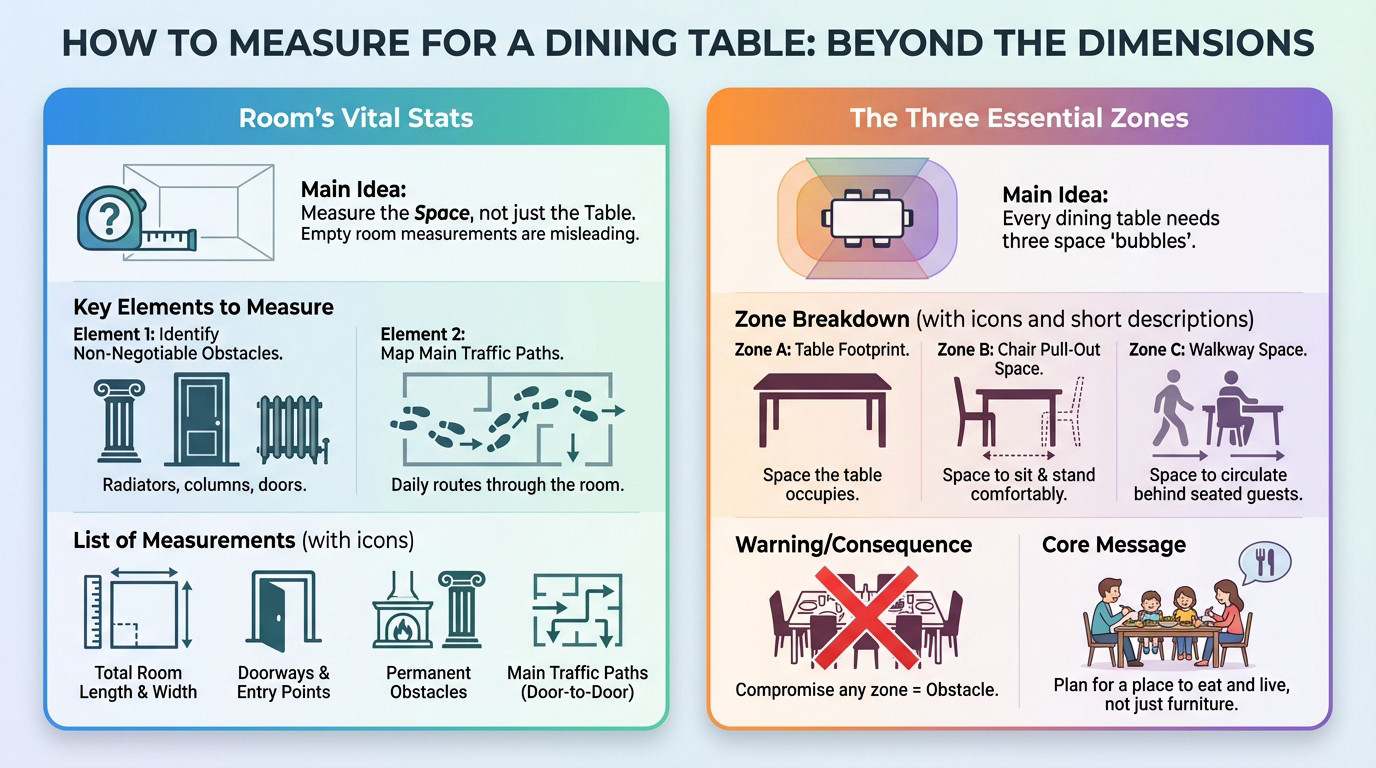
The Vital Stats of Your Dining Space
Start by ignoring the table for a moment. Your first job is measuring the room itself, but be warned: measurements of an empty room are dangerously misleading. They lie about the usable space.
Grab your tape measure and find the hard limits. You must identify "non-negotiable obstacles" like radiators, skirting boards, swinging doors, or support columns. These fixed elements dictate where furniture can actually go. Ignore them, and nothing fits.
Next, map out your traffic paths. These are the invisible routes you walk daily across the room.
- The total length and width of the room.
- Doorways, entry points, and window sills.
- Permanent obstacles (fireplaces, support columns, built-in cabinetry).
- Main traffic paths from one door to another.
The Three Functional Zones You Can't Ignore
Every dining setup relies on three specific zones to work properly. You need the table's footprint, adequate space for chairs, and a clear lane for circulation. Without all three, flow dies.
Let’s define these clearly. The Table footprint is just the surface area. The chair pull-out space needs 60cm for sitting down. The walkway space is the extra buffer for walking past.
If you compromise one of these zones, the table becomes a massive roadblock. The comfort is gone, and the room feels cramped immediately. You ruin the functionality of the entire space.
A dining table doesn't exist in a vacuum. If you only plan for the table's footprint, you've planned for a piece of furniture, not a place to eat and live.
Decoding the Clearance Rules That Actually Matter
Raw room dimensions are useless without context. To properly measure space for a dining table and avoid regret, we must look at the clearance distances that make a room actually livable.
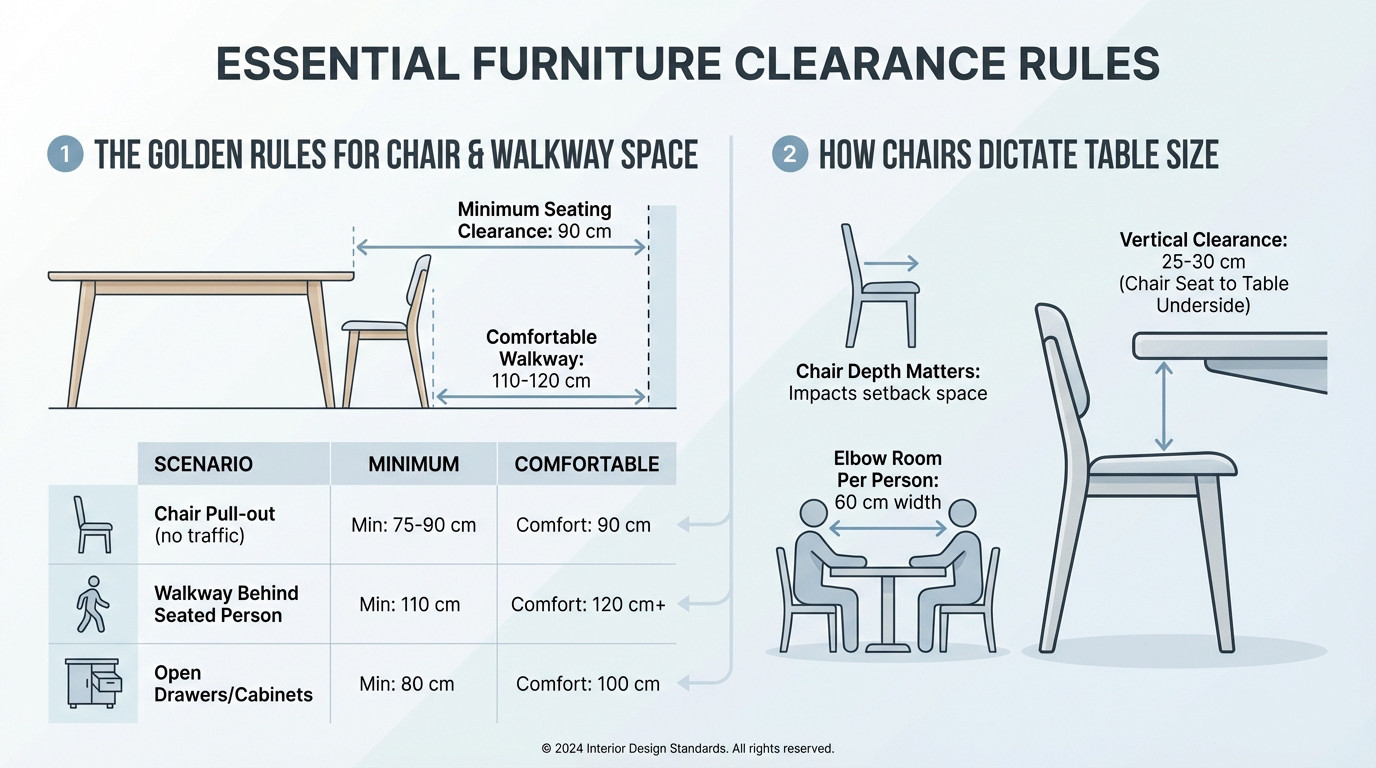
The Golden Rule for Chair and Walkway Space
A dining table isn't static. You need room to sit, plus distinct space for walking behind chairs. Ignoring this distinction creates major bottlenecks in your home.
The non-negotiable number for minimum clearance is 90 cm. This is the distance from the table edge to the nearest wall just to pull a chair out comfortably.
For a functional walkway behind seated diners, the requirement jumps to 110-120 cm. This allows circulation without anyone feeling crowded or having to shuffle their chair forward.
| Scenario | Minimum Clearance | Comfortable Clearance |
|---|---|---|
| Chair pull-out (no traffic behind) | 75-90 cm | 90 cm |
| Walkway behind a seated person | 110 cm | 120 cm+ |
| Space to open drawers/cabinets | 80 cm | 100 cm |
Why Your Chairs Dictate the Final Table Size
Picking the table before the chairs is a fundamental error. The chairs, not the table, actually determine the real footprint and usable space in your room.
Consider geometry. A chair with a deep seat or angled back eats up more floor space. Add armrests, and you lose precious centimetres that standard plans ignore.
You also need "elbow room" to avoid dinner combat. We strictly recommend allowing 60 cm of width per diner, according to experts at Wirecutter. Anything less forces guests to squeeze in.
Finally, check vertical space: aim for 25-30 cm between the seat and table top. This ensures enough legroom.
How Table Shape and Room Layout Change the Game
Clearance numbers are just the starting point. If you ignore the actual geometry of your room, you are still flying blind. Here is how to make the puzzle pieces fit.
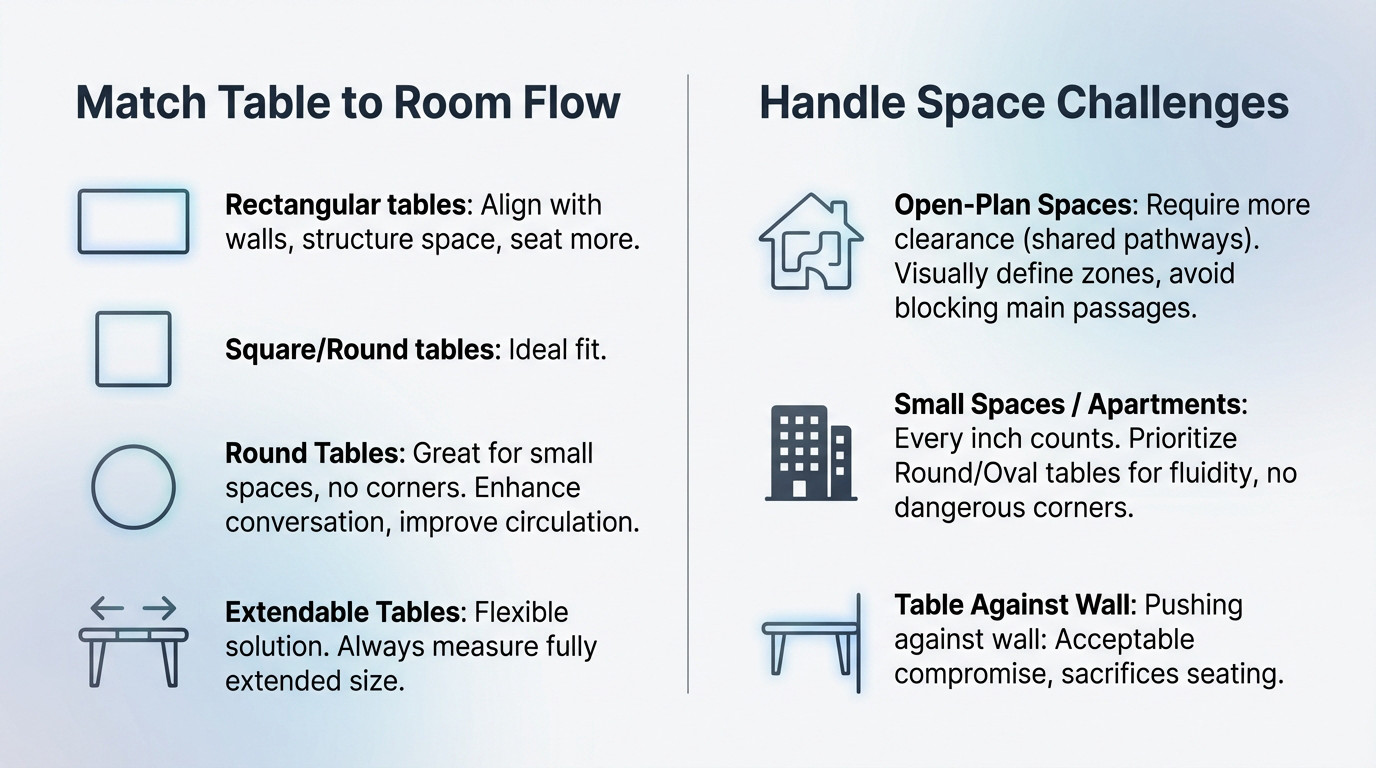
Matching Table Shape to Your Room's Flow
You have to work with the room, not fight against it. Rectangular rooms naturally demand rectangular tables. Conversely, square rooms feel awkward with long tables; they scream for square or round designs.
Round tables are the ultimate problem solvers. Without sharp corners to dodge, traffic flows smoothly around the perimeter. A piece like our Earth Round Sintered Stone Table can adoucir the angles of a room and keeps conversation intimate.
For larger families, rectangular tables are the standard for a reason. They maximise seating capacity and align naturally with long walls. They structure the space, exactly like our ZARA Sintered Stone Dining Table does in a dedicated dining zone.
Extendable tables offer brilliant flexibility, but don't get caught out. Always measure your available floor space based on the table fully extended, not its daily compact size.
The Challenges of Open-Plan and Small Spaces
People assume open-plan living means endless space, but that is a dangerous myth. You actually need more clearance here because your dining area shares vital traffic lanes with the kitchen and lounge. You cannot block the flow.
Use your table to zone the area visually without building walls. Just ensure you aren't severing the main artery between the sofa and the fridge or blocking sightlines.
In small spaces and apartments, every millimetre is a battleground. Forget bulky corners; prioritise round or oval shapes to keep walkways clear. This prevents hip-bumping accidents and keeps the visual weight light in a cramped footprint.
Pushing a table against a wall is a valid survival tactic. It saves floor space, but remember you are permanently sacrificing those wall-side seats.
How to Avoid Buyer's Remorse and Common Blunders
The theory is fine, but before you tap your card, you need a reality check. Skipping this practical step is the quickest way to end up with a room that doesn't work.
Test Your Layout in the Real World—Before You Buy
Don't just rely on the math or a sketch. You need to physically test the space to really understand the flow.
Here is the trick we use. Grab some masking tape and mark the table's outline on your floor. Then, place cardboard boxes or spare chairs to mimic the bulk of occupied seats.
Don't rush this step; live with the mockup for forty-eight hours. Walk past it with groceries, pull out a fake chair, and open every cupboard nearby.
A floor plan is a guess. A cardboard cutout on your floor is a fact. Trust the fact, not the guess, before you spend a dollar.
The Classic Measurement Mistakes We See in Canberra Homes
We see the same blunders constantly in Canberra. Most are totally avoidable. We summarized these hard lessons in our piece on what we learned furnishing over 600 Canberra homes.
The biggest error is measuring wall-to-wall only without accounting for movement. You might measure space for dining table footprints, but you forget the chairs and traffic.
- Forgetting about door swings and the space needed.
- Not considering future furniture additions like a sideboard or a bar cart.
- Trusting the spacious feel of a showroom instead of your own room's reality.
- Forgetting to measure the delivery path: doorways, stairwells, and tight corners.
Finally, never ignore the delivery route. Buying a lounge that won't fit through your front door is a nightmare. It's a critical final check.
Don’t let a beautiful table become a daily frustration. By measuring your room’s flow, respecting clearance zones, and testing the layout physically, you ensure your dining space works for real life. Grab your tape measure, map out those traffic paths, and choose a table that fits your home perfectly.
FAQ
How much space do I need around a dining table for comfortable movement?
You should allow a minimum clearance of 90 cm between the edge of your table and the nearest wall or piece of furniture. This distance provides just enough room for a guest to pull out their chair and sit down comfortably without feeling trapped.
If the area behind the chair is a main traffic path, increase this clearance to 110–120 cm. This ensures that someone can walk past a seated diner without forcing them to tuck in their chair or interrupting the meal.
How do I decide between a round and a rectangular dining table?
Your choice should largely be dictated by the shape of your room. Rectangular tables work best in rectangular rooms, aligning with the walls to maximise seating capacity. They are excellent for defining the dining zone in open-plan spaces.
Conversely, round tables are ideal for square rooms or smaller dining nooks. Because they lack sharp corners, they improve traffic flow and make tight spaces feel larger. To choose, measure your room, subtract the 90 cm clearance on all sides, and see which shape fits the remaining footprint best.
How much table width should be allocated per person?
To prevent guests from bumping elbows while eating, you should allocate a minimum of 60 cm of table width per person. This provides sufficient space for a standard place setting and comfortable movement.
If you plan to use dining chairs with arms or wider frames, it is safer to allow 70 to 75 cm per person. Always check the width of your chairs against the table legs to ensure they can tuck in fully when not in use.
What is the correct height distance between the chair seat and the table top?
For adequate legroom and comfortable dining posture, aim for a gap of 25 to 30 cm between the top of the chair seat and the underside of the table top (or apron). If the gap is smaller, guests may trap their thighs; if it is larger, the table will feel uncomfortably high.